


Page 24 - Bristol Magazine Spring 2025
P. 24
HISTORY
            HISTOR                                                                              Y


                   Bristol Cultural District

           IN      Bristol Cultural District
         THE


                                                                                     by Bristol Historical Society
      In  2022,  the  State  of  Connecticut  olutionary  cause.  The  conflicts  and  Watch  Museum  has  showcased
      officially approved Bristol’s Cultural  violence that ensued drove the An-  clocks and clockmaking from around
      District.  The  new  designation  cov-  glican church members out of Bris-  the  world,  but  you’ll  find  plenty
      ers the Federal Hill, Memorial Bou-   tol—no Episcopal Church would re-    of  Bristol  history  in  the  museum’s
      levard, and much of the Downtown  turn to Bristol until midway through  building and exhibits. The museum
      area. The area’s cultural attractions  the nineteenth century. All that re-  itself is located partially in the 1801
      are  inextricably  linked  to  the  city’s  main of the Anglican community is  Miles Lewis House. Its new wing fea-
      history.  Knowing  a  little  bit  more  a small graveyard off Stearns Street  tures paneling from the homestead
      about  the  history  of  the  areas  in-  behind the apartment building.   of  Ebenezer  Barnes,  Bristol’s  first
      volved can only add to residents’ en-                                      permanent  settler.  The  museum’s
      joyment of Bristol’s resources.                                            permanent  exhibits  will  acquaint
                                                                                 you with one of the industries that
                                                                                 helped  transform  Bristol  into  a
      The city’s story could be said to be-                                      wealthy industrial city. This summer
      gin  with  the  area  around  Federal                                      a special exhibition will celebrate the
      Hill  Green.  In  1742,  the  residents                                    impact  of  African-American  clock
      of  what  was  then  called  the  West                                     and watch makers on the industry.
      Woods area petitioned the Colonial                                         In  2024,  the  museum  was  gifted  a
      Legislature to form their own eccle-                                       Peter Hill tall clock. Hill (1767–1820)
      siastical community, in other words,                                       of Burlington Township, New Jersey,
      their own church. Their petition was                                       was the first known black clockmak-
      granted,  with  a  few  conditions—                                        er in America; the only one known to
      for  instance,  the  new  community                                        have worked in the late eighteenth
      would  have  to  establish  a  school                                      and  early  nineteenth  centuries.  Al-
      nearby.  That  church  community                                           though he was not an inventor, Hill
      became what is now the still-thriv-                                        was certainly a pioneer. Today, there
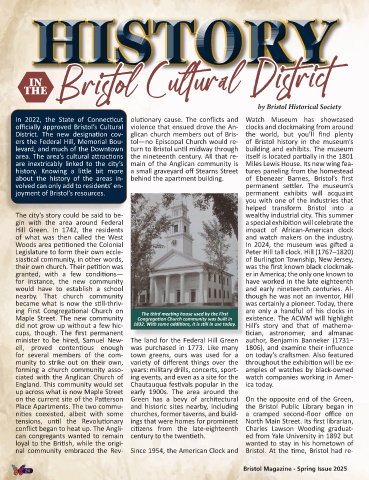
      ing  First  Congregational  Church  on   The third meeting house used by the First   are  only  a  handful  of  his  clocks  in
      Maple  Street.  The  new  community     Congregation Church community was built in   existence. The ACWM will highlight
      did not grow up without a few hic-     1832. With some additions, it is still in use today.  Hill’s  story  and  that  of  mathema-
      cups,  though.  The  first  permanent                                      tician,  astronomer,  and  almanac
      minister  to  be  hired,  Samuel  New-  The land for the Federal Hill Green  author,  Benjamin  Banneker  (1731–
      ell,  proved  contentious  enough  was  purchased  in  1773.  Like  many  1806), and examine their influence
      for  several  members  of  the  com-  town  greens,  ours  was  used  for  a  on today’s craftsmen. Also featured
      munity  to  strike  out  on  their  own,  variety  of  different  things  over  the  throughout the exhibition will be ex-
      forming  a  church  community  asso-  years: military drills, concerts, sport-  amples of watches by black-owned
      ciated with  the  Anglican  Church  of  ing events, and even as a site for the  watch companies working in Amer-
      England. This community would set  Chautauqua festivals popular in the  ica today.
      up across what is now Maple Street  early  1900s.  The  area  around  the
      on the current site of the Patterson  Green  has  a  bevy  of  architectural  On the opposite end of the Green,
      Place Apartments. The two commu-      and  historic  sites  nearby,  including  the  Bristol  Public  Library  began  in
      nities  coexisted,  albeit  with  some  churches, former taverns, and build-  a  cramped  second-floor  office  on
      tensions,  until  the  Revolutionary  ings that were homes for prominent  North Main Street. Its first librarian,
      conflict began to heat up. The Angli-  citizens  from  the  late-eighteenth  Charles  Lawson  Wooding  graduat-
      can  congregants  wanted  to  remain  century to the twentieth.            ed from Yale University in 1892 but
      loyal to the British, while the origi-                                     wanted to stay in his hometown of
      nal  community  embraced  the  Rev-   Since 1954, the American Clock and  Bristol. At the time, Bristol had re-


         24                                                                      Bristol Magazine - Spring Issue 2025

