


Page 6 - Bristol Magazine Spring 2025
P. 6
Ten Generations
         Ten                   Gen                               eration                                    s


                 by Thomas Dickau                  OF CONTRIBUTIONS

         BY THE CITY’S FIRST TWO FAMILIES


      The  first  two  permanent  settlers  of                                   Bristol Brass employees, but due to de-
      what  would  become  the  City  of  Bris-                                  terioration after 211 years, it was taken
      tol, were Ebenezer Barns (the “e” was                                      down in 1939.
      added three generations later) and Ne-
      hemiah Manross. In 1728, Barnes with                                       The New England states were becoming
      his son Stephen, left his home in Farm-                                    engaged in two waves of the American
      ington and traveled west through “The                                      Industrial  Revolution  during  the  nine-
      Great Forest “or “West Woods” to fine                                      teenth  and  early  twentieth  centuries.
      suitable land for farming and the con-                                     Industrialization  was  transforming  the
      struction of a home. Although this land                                    area from an agrarian style of living to
      had  been  secured  over  a  half  century                                 a more urban based lifestyle.
      earlier,  considered  too  rocky  and  hilly
      for  an  agrarian  lifestyle,  it  remained                                The  Wallace  Barnes  Company  opened
      a  hunting  and  fishing  reserve  for  the                                in 1857 and was joined by the Dunbar
      friendly  Tunxis  Indians.  Barnes,  the                                   Spring  Company  in  the  manufacturing
      community’s  first  permanent  settler,                                    of a variety of springs needed by clock-
      built his home on a plains area extend-                                    makers.  They  also  began  production
      ing  to  Plainville  along  the  Pequabuck                                 of  hoops  needed  for  crinoline  skirts.
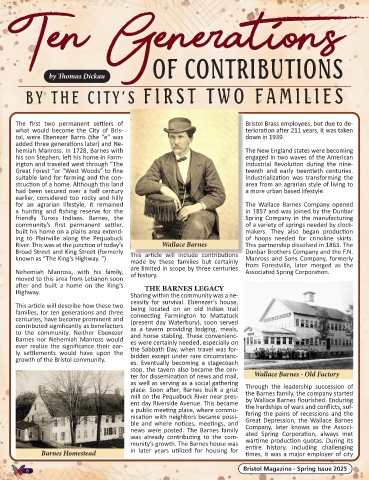
      River. This was at the junction of today’s      Wallace Barnes             This partnership dissolved in 1863. The
      Broad Street and King Street (formerly   This  article  will  include  contributions   Dunbar Brothers Company and the F.N.
      known as “The King’s Highway. “)      made  by  these  families  but  certainly   Manross  and  Sons  Company,  formerly
                                                                                 from  Forestville,  later  merged  as  the
      Nehemiah  Manross,  with  his  family,   are limited in scope by three centuries   Associated Spring Corporation.
                                            of history.
      moved to this area from Lebanon soon
      after  and  built  a  home  on  the  King’s   THE BARNES LEGACY
      Highway.                              Sharing within the community was a ne-
      This article will describe how these two   cessity  for  survival.  Ebenezer’s  house,
                                            being  located  on  an  old  Indian  trail
      families, for ten generations and three   connecting  Farmington  to  Mattatuck
      centuries, have become prominent and   (present  day  Waterbury),  soon  served
      contributed significantly as benefactors   as  a  tavern  providing  lodging,  meals,
      to  the  community.  Neither  Ebenezer   and horse stabling. These convenienc-
      Barnes  nor  Nehemiah  Manross  would   es were certainly needed, especially on
      ever  realize  the  significance  their  ear-  the Sabbath Day, when travel was for-
      ly  settlements  would  have  upon  the   bidden except under rare circumstanc-
      growth of the Bristol community.      es.  Eventually  becoming  a  stagecoach
                                            stop, the tavern also became the cen-
                                            ter for dissemination of news and mail,   Wallace Barnes - Old Factory
                                            as well as serving as a social gathering
                                            place.  Soon  after,  Barnes  built  a  grist   Through  the  leadership  succession  of
                                            mill on the Pequabuck River near pres-  the Barnes family, the company started
                                            ent day Riverside Avenue. This became   by Wallace Barnes flourished. Enduring
                                            a public meeting place, where commu-  the hardships of wars and conflicts, suf-
                                            nication with neighbors became possi-  fering the pains of recessions and the
                                            ble  and  where  notices,  meetings,  and   Great  Depression,  the  Wallace  Barnes
                                            news  were  posted.  The  Barnes  family   Company,  later  known  as  the  Associ-
                                            was  already  contributing  to  the  com-  ated  Spring  Corporation,  always  met
                                            munity’s growth. The Barnes house was   wartime production quotas. During its
                                                                                 entire  history,  including  challenging
               Barnes Homestead             in  later  years  utilized  for  housing  for   times, it was a major employer of city

          6                                                                      Bristol Magazine - Spring Issue 2025

