


Page 8 - Bristol Magazine Spring 2025
P. 8
and Clock Company was organized. Eli-  mer term of 1862 at Amherst, he wrote
                                            sha served as one of its directors. This  a letter to his wife expressing his feel-
                                            company served the area for 132 years  ings,  “You  can  better  afford  to  have  a
                                            before it closed in 1982.            country without a husband, than a hus-
                                                                                     band without a country”.
                                            Like his father, Elisha held ex-
                                            tensive  tracts  of  land.  He                  He  assumed  the  captaincy
                                            sold  the  land  between                          of a newly formed Bristol
                                            Stafford Avenue and the                            company.  Three  weeks
                                            village  center  to  the                             later  in  1862,  Compa-
                                            town. Church Avenue                                  ny K of the Sixteenth
                                            was built to connect                                  Connecticut    Vol-
                                            these two areas.                                       unteer   Regiment
                                                                                                   entered  camp  in
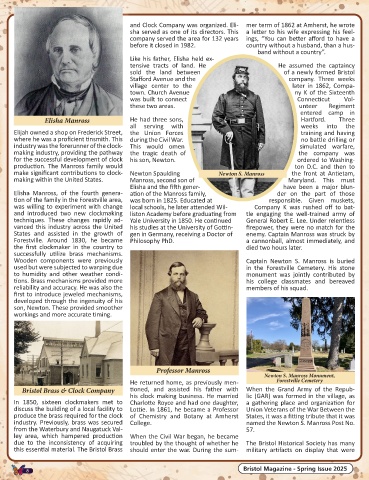
                Elisha Manross              He had three sons,                                     Hartford.    Three
                                            all  serving  with                                     weeks    into   the
      Elijah owned a shop on Frederick Street,  the  Union  Forces                                 training and having
      where he was a proficient tinsmith. This  during the Civil War.                              no battle drilling or
      industry was the forerunner of the clock-  This  would  omen                                 simulated  warfare,
      making industry, providing the pathway  the  tragic  death  of                               the  company  was
      for the successful development of clock  his son, Newton.                                   ordered to Washing-
      production. The Manross family would                                                       ton  D.C.  and  then  to
      make significant contributions to clock-  Newton Spaulding        Newton S. Manross       the  front  at  Antietam,
      making within the United States.      Manross, second son of                             Maryland.  This  must
                                            Elisha and the fifth gener-                       have  been  a  major  blun-
      Elisha  Manross,  of  the  fourth  genera-  ation of the Manross family,              der  on  the  part  of  those
      tion of the family in the Forestville area,  was born in 1825. Educated at         responsible.  Given  muskets,
      was willing to experiment with change  local schools, he later attended Wil-  Company  K  was  rushed  off  to  bat-
      and  introduced  two  new  clockmaking  liston Academy before graduating from   tle  engaging  the  well-trained  army  of
      techniques.  These  changes  rapidly  ad-  Yale University in 1850. He continued   General Robert E. Lee. Under relentless
      vanced this industry across the United  his studies at the University of Gottin-  firepower, they were no match for the
      States  and  assisted  in  the  growth  of  gen in Germany, receiving a Doctor of   enemy. Captain Manross was struck by
      Forestville.  Around  1830,  he  became  Philosophy PhD.                   a cannonball, almost immediately, and
      the  first  clockmaker  in  the  country  to                               died two hours later.
      successfully  utilize  brass  mechanisms.
      Wooden  components  were  previously                                       Captain  Newton  S.  Manross  is  buried
      used but were subjected to warping due                                     in  the  Forestville  Cemetery.  His  stone
      to  humidity  and  other  weather  condi-                                  monument  was  jointly  contributed  by
      tions. Brass mechanisms provided more                                      his  college  classmates  and  bereaved
      reliability and accuracy. He was also the                                  members of his squad.
      first to introduce jeweled mechanisms,
      developed through the ingenuity of his
      son, Newton. These provided smoother
      workings and more accurate timing.


                                                    Professor Manross
                                                                                       Newton S. Manross Monument,
                                            He returned home, as previously men-           Forestville Cemetery
        Bristol Brass & Clock Company       tioned,  and  assisted  his  father  with  When  the  Grand  Army  of  the  Repub-
                                            his clock making business.  He married  lic (GAR) was formed in the village, as
      In  1850,  sixteen  clockmakers  met  to  Charlotte Royce and had one daughter,  a  gathering  place  and  organization  for
      discuss the building of a local facility to  Lottie. In 1861, he became a Professor  Union Veterans of the War Between the
      produce the brass required for the clock  of  Chemistry  and  Botany  at  Amherst  States, it was a fitting tribute that it was
      industry. Previously, brass was secured  College.                          named the Newton S. Manross Post No.
      from the Waterbury and Naugatuck Val-                                      57.
      ley  area,  which  hampered  production  When the Civil War began, he became
      due  to  the  inconsistency  of  acquiring  troubled by the thought of whether he  The Bristol Historical Society has many
      this essential material. The Bristol Brass  should enter the war. During the sum-  military  artifacts  on  display  that  were


          8                                                                      Bristol Magazine - Spring Issue 2025

